Can Jewelry Be Engraved Later? A Fine Guide
A bracelet may begin as a birthday gift, a ring as a quiet promise to oneself, a charm as a small reminder of someone dearly loved. Then life adds another layer of meaning. Can jewelry be engraved later? In many cases, yes. A skilled jeweler can often add an inscription long after a piece is made, turning a beautiful object into one that holds a particular date, name, place, or private phrase.
But engraving is not a universal afterthought. The answer depends on the metal, the shape of the piece, its setting, its existing finish, and the amount of open space available. Fine jewelry deserves a considered approach, especially when it is meant to be worn through summers by the water, dinners that run late, and the ordinary days that become part of a life story.
Can Jewelry Be Engraved Later Without Damage?
Usually, engraving later is entirely possible when a piece has a smooth, substantial surface and is in good condition. The inside of a ring band, the back of a pendant, a bracelet clasp, or the reverse of a charm are all familiar places for a personal inscription. A jeweler will assess the piece before recommending the right method and placement.
The key consideration is thickness. Engraving removes a very small amount of material, but a delicate band or an especially fine charm may not have enough depth to accommodate it safely. This is also true of hollow pieces, where engraving too deeply could compromise the structure.
Pieces with pavé diamonds, intricate handwork, enamel, or a highly textured surface require additional care. An inscription may still be possible, but it may need to be smaller, placed elsewhere, or executed with a lighter touch. A thoughtful jeweler will never force an engraving where it does not belong. The loveliest result is one that feels as though it was always part of the design.
What Makes a Piece Suitable for Later Engraving?
Gold is generally an excellent material for engraving. Yellow, white, and rose gold can all be engraved by hand or with a laser, though the karat and finish influence the final appearance. Platinum is durable and beautifully enduring, but its density can make hand engraving more demanding. Sterling silver is also receptive to engraving, though it may show wear more readily over time.
Beyond the metal, scale matters. A substantial signet ring offers generous room for initials, a family crest, or a symbol. A petite pendant may call for a single letter, a date in a fine typeface, or a discreet word on its reverse. The message should be chosen with the dimensions of the jewelry in mind. There is romance in restraint.
Condition matters, too. Jewelry that has been worn for years may have thinning metal, small scratches, or previous repairs. These do not automatically rule out engraving, but they should be evaluated first. It can be wise to have prongs, clasps, and structural details checked at the same appointment, particularly for a piece that has become part of everyday wear.
Existing Engravings Can Often Be Revised
An older inscription is not always permanent. Depending on its depth and the amount of metal available, a jeweler may be able to polish away a previous engraving and create a new one. This is common with estate rings, inherited lockets, and wedding bands that are being reimagined for a new chapter.
There is a trade-off. Removing an engraving takes away metal and may slightly alter a surface, so it is not the right choice for every heirloom. Sometimes the original words deserve to remain, even if they belong to another generation. In those instances, a new inscription can be placed elsewhere, allowing the past and present to sit together.
Hand Engraving or Laser Engraving?
Both methods have a place in fine jewelry, and the best choice is guided by the piece itself and the feeling you want it to carry.
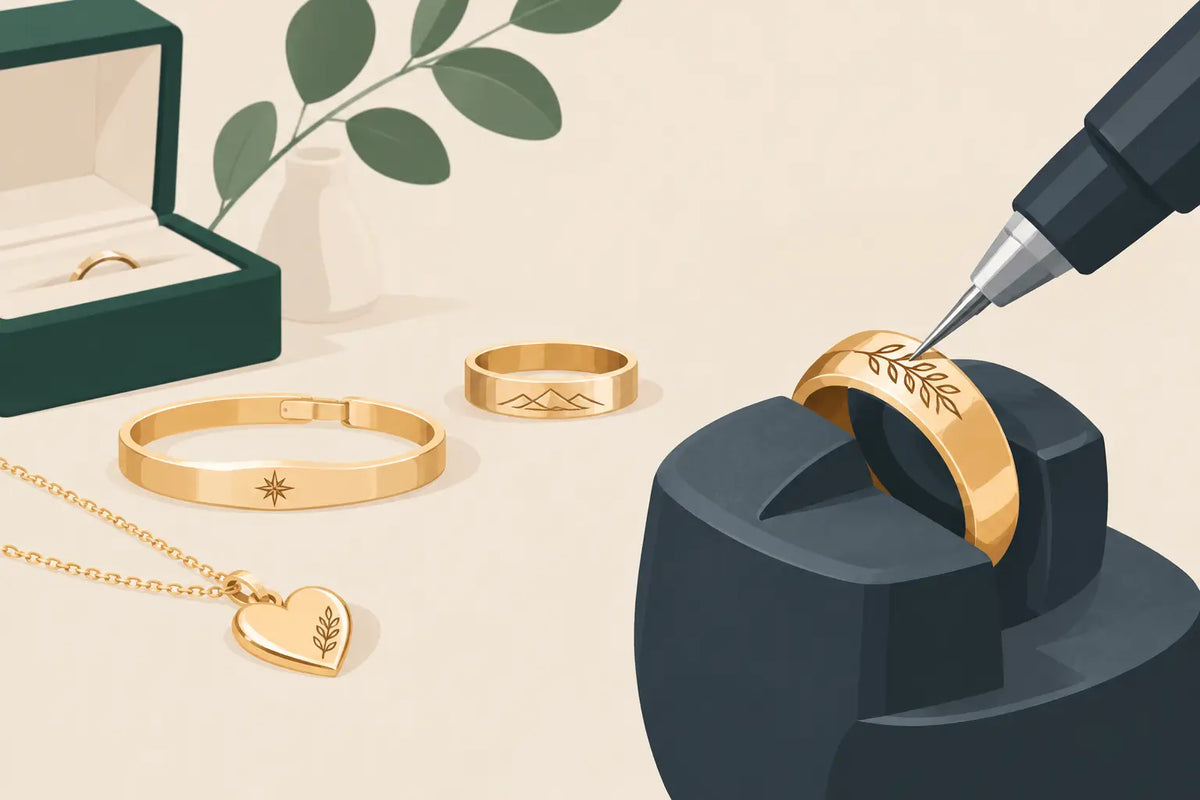
Hand engraving is created by an artisan using traditional tools. It has a living quality: each line catches light differently, and tiny variations make the work feel unmistakably human. This approach is especially beautiful for monograms, script, decorative borders, and designs intended to become part of an heirloom's character. It is typically more time-intensive and may require a larger, flatter surface.
Laser engraving uses precise technology to create very fine lettering and detailed imagery. It can be ideal for small spaces, longer inscriptions, coordinates, fingerprints, or handwriting reproductions. A laser can also create a subtle result that sits quietly against the metal, almost like a secret kept close to the skin.
Neither method is inherently more meaningful. A hand-engraved date may feel like a love letter written in metal. A laser-engraved line from a note can preserve the exact rhythm of a loved one's hand. The right choice is the one that honors the story you wish to keep.
Choosing Words That Will Stay With You
An engraving is small, but it can carry a remarkable amount. Before settling on a phrase, consider what you would want to find if you held the piece twenty years from now. Often, the most enduring inscriptions are specific rather than grand.
A date can hold the memory of a wedding, a birth, a first home, or the August afternoon when everything changed. Initials offer intimacy without explanation. Coordinates can point toward a shoreline, a childhood house, or the city where two lives first crossed. A few words in a loved one's handwriting can feel almost talismanic.
Longer messages are possible on wider bands, lockets, and substantial pendants, but legibility should lead the decision. Tiny lettering that cannot be read loses some of its tenderness. Let the available space guide the message rather than asking the jewelry to carry more than it can gracefully hold.
For a gift, consider whether the recipient would prefer something openly sentimental or more private. A date visible only when a ring is removed can be deeply personal. An initial on the face of a signet makes a different kind of statement: confident, considered, and meant to be seen.
Timing Matters, Especially Before Resizing or Repairs
If you know you would like an engraving, mention it before a ring is resized or a piece is restored. Resizing can stretch, compress, or remove part of an inscription, particularly when words are placed along the inside of a band. In many cases, engraving should happen after resizing, once the final fit is established.
The same principle applies to refinishing. Polishing can soften shallow engraving over time, while a matte or brushed finish may change how lettering appears. A jeweler can advise whether the piece should be polished first, engraved second, and left with its final finish afterward.
For jewelry with gemstones, professional inspection is especially valuable. While engraving is generally performed away from stones, heat, pressure, and handling should be managed carefully. This is not a moment for a rushed personalization kiosk or a service that cannot examine the piece in person.
How to Care for an Engraved Piece
An engraving will naturally develop character with wear. On a ring worn every day, the lettering may soften over decades, much as a favorite linen napkin becomes gentler with use. This is not necessarily damage. It can be evidence of a life fully lived.
To preserve clarity, remove engraved jewelry before heavy work, exercise, swimming, or exposure to household chemicals. Store it separately when possible, and have it inspected periodically by a trusted jeweler. If an inscription begins to fade, it may sometimes be refreshed, provided there is enough metal and the original work has not been excessively polished.
Fine jewelry is often chosen for its beauty in the moment. Engraving asks it to do something more intimate: to keep a name close, to mark a turning point, to carry sunlight and sea air from one season into another. Whether added at the beginning or years later, the right inscription gives a piece its second life - not merely as jewelry, but as something to return to.