Article: Ring Stacking Techniques for a Personal Look
Ring Stacking Techniques for a Personal Look
A ring stack can hold more than a point of view. It can carry the feeling of a summer evening, the weight of a promise, or the quiet pleasure of choosing something beautiful for yourself. The most considered ring stacking techniques are less about following a formula and more about building a composition that feels instinctively personal - jewelry that settles onto the hand as naturally as sunlight on the skin.
The appeal is in the evolution. A stack need not arrive all at once. It may begin with a ring chosen to mark a birthday or new beginning, then grow slowly through gifts, travels, anniversaries, and passing seasons. When each piece has a reason to be there, the finished effect feels collected rather than styled.
Start With One Ring That Anchors the Story
Every memorable stack has a center of gravity. This might be a substantial gold band, an antique-inspired signet, a ring with a meaningful stone, or a sculptural silhouette whose proportions you return to again and again. Choose the piece that feels most like you, then let it guide the rest.
A wider band has visual presence and often works best when paired with finer rings that leave space around it. A delicate diamond or gemstone ring, on the other hand, can be given more definition by a smooth gold band nearby. The goal is not perfect symmetry. It is balance - a sense that each ring has been chosen in conversation with the next.
If your anchor ring is sentimental, allow it to lead. A family stone, a wedding band, or a piece made from revived jewelry deserves to remain visible. Fine jewelry becomes most compelling when its history is not hidden beneath decoration.
Ring Stacking Techniques That Begin With Proportion
Before considering color or sparkle, consider scale. The hand is a small canvas, and proportion changes the entire mood of a stack. A group of ultra-fine bands can feel delicate and light, while a mixture of narrow and medium widths has a more confident, layered presence.
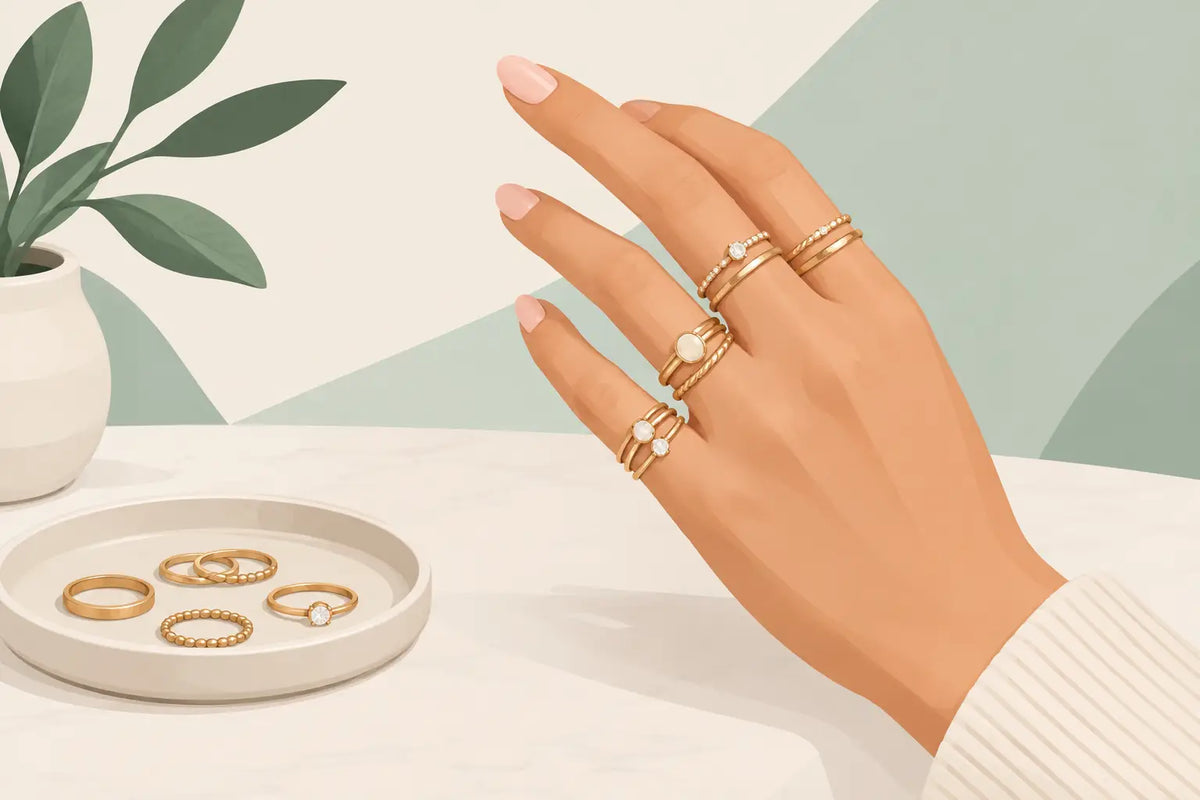
Try placing a wider ring at the base of a finger and graduating toward slimmer bands above it. The eye naturally follows this shift in width, creating a stack that feels intentional without becoming overly formal. Alternatively, frame a slender stone-set ring with two plain bands. This approach gives a precious center ring a soft architectural outline.
Negative space matters, too. Not every finger needs to be filled, and not every ring needs a companion. A stack that leaves one finger bare or places a single strong ring on the opposite hand feels relaxed and lived-in. Restraint is often what allows fine materials and thoughtful details to speak.
There is no fixed number of rings that makes a stack complete. Two rings can feel as expressive as seven. It depends on the scale of your hands, the rings themselves, and whether you want a quiet everyday arrangement or a more celebratory gesture.
Let Comfort Shape the Composition
The most beautiful stack is one you will actually wear. Rings should sit comfortably beside one another, without pinching at the knuckle or forcing your fingers apart. If two wider bands compete for the same space, move one to another finger or add a narrower piece between them.
Pay attention to the profile as well as the face of a ring. Low-set stones and gently rounded bands tend to suit daily wear, especially if you work with your hands or prefer jewelry you do not have to think about. Taller settings create wonderful drama, but they may be better reserved for a stack that is edited around them rather than crowded beside them.
Mix Texture, Not Just Metals
A stack made entirely of matching bands can be elegant, especially when you want an understated look. Yet texture is what brings depth to a personal collection. Pair a polished surface with a softly brushed finish, an organic contour with a crisp edge, or a hammered band with a smooth, rounded silhouette. These subtle contrasts catch the light differently and make each piece more distinct.
Gold is especially forgiving in this respect. Yellow gold offers warmth and a familiar, sunlit glow. White gold brings a cooler clarity, while rose gold can lend softness to a composition. Mixing metals is no longer a rule to break. It is simply a choice. A yellow-gold foundation with one white-gold or platinum-toned ring can look modern and unstudied, particularly when the shapes share a similar level of refinement.
The trade-off is visual noise. If you are mixing metals, keep another element consistent: perhaps all bands are slender, all stones are clear, or all surfaces have an organic softness. Repetition gives contrast a place to rest.
Give Gemstones Room to Breathe
Gemstones can become the emotional punctuation in a ring stack. A diamond band offers light and precision; a colored stone introduces mood, memory, and a sense of the unexpected. Rather than surrounding every gem with more sparkle, place stone-set rings beside plain gold bands so the color and setting remain legible.
Consider the direction of your stones, too. A marquise, pear, or oval shape may point toward the fingertip for a lengthening effect, or toward the hand for something more intimate and unusual. Alternating the orientation of shaped stones can create movement, though it works best when the rest of the stack remains restrained.
If you wear an engagement ring, the adjacent bands should support its silhouette rather than compete with it. A curved band may nestle closely against a prominent setting, while a straight band creates a sliver of air that can look equally beautiful. There is no need to force a flush fit. A small, intentional gap often gives the stack a more individual character.
Spread the Story Across Both Hands
A stack does not have to live on one finger. In fact, distributing rings across both hands can make a collection feel more effortless. Place your most sentimental ring on the hand where you will see it often. Then balance it with a simple band, pinky ring, or signet on the other hand.
For an everyday arrangement, try keeping one hand slightly fuller and the other quieter. You might wear a paired stack on the ring finger, a single band on the index finger, and one small accent on the opposite hand. The effect is polished, but never overly arranged.
This is also a practical way to wear rings that do not naturally nest. Pieces with strong profiles, large stones, or wide faces often shine brightest when given their own territory. Spreading them out lets each design retain its presence.
Build a Stack Over Time
The loveliest ring stacks rarely look purchased in a single afternoon. They carry the subtle variation of a life well lived: a band given after a graduation, a stone chosen on a meaningful trip, a ring remade from a grandmother's jewelry, a small gold piece bought simply because it marked a season worth remembering.
This slower approach also gives you time to understand what you wear. You may discover that you favor rounded forms over sharp geometry, warm gold over cool metal, or one meaningful gemstone more than a field of diamonds. These preferences are not limitations. They are the beginnings of a signature.
At Fourteen August, the idea of jewelry as a personal touchstone is central to this way of wearing rings. A carefully made piece can stand alone, then gather new meaning as it joins the rings that come after it. That is the quiet luxury of a stack: it changes with you while holding close what you do not want to lose.
When choosing your next ring, do not ask only whether it matches what you already own. Ask what memory it might hold, what it adds to the rhythm of your hand, and whether you will still reach for it years from now. The answer is usually the piece worth making room for.