How to Restyle Old Charms Into New Heirlooms
A charm can be small enough to disappear into a jewelry box, yet still carry an entire chapter of a life. A graduation date, a tiny gold horse, a faded locket, a souvenir brought home from a long-ago summer. Learning how to restyle old charms is not about erasing their past. It is about letting those private symbols meet the way you dress, live, and mark time now.
The most successful remakes feel neither overly precious nor overly polished. They retain a little of the original spirit - the worn edge, the familiar engraving, the tiny imperfection that proves the piece has been loved. With thoughtful design, old charms can become jewelry you reach for every morning: close to the collarbone, layered at the wrist, or carried on a chain with new meaning.
Begin With the Story, Not the Setting
Before choosing a chain or sketching a new silhouette, gather every charm you are considering and spend time with them. Notice what each one represents. Some belong together because they came from the same bracelet; others may share a quieter connection, such as places you have lived, women in your family, or the seasons that shaped you.
This first edit is often emotional. A charm does not need to be conventionally beautiful to deserve a place in the final piece. A worn religious medal, a child’s initial, or a small token with an unfamiliar hallmark may be the very element that makes a design feel like yours. At the same time, not every charm needs to be worn at once. Leaving a few pieces aside can create breathing room and make the chosen symbols more resonant.
Consider the jewelry you already wear most. If your days call for a crisp white shirt, a fine chain at the throat, and a watch or slim bangle, a crowded charm bracelet may not feel natural. If you favor linen dresses, stacked gold, and sun-warmed skin, a fuller composition may suit you beautifully. The goal is not to preserve an old arrangement exactly. It is to make memory wearable again.
How to Restyle Old Charms for Everyday Wear
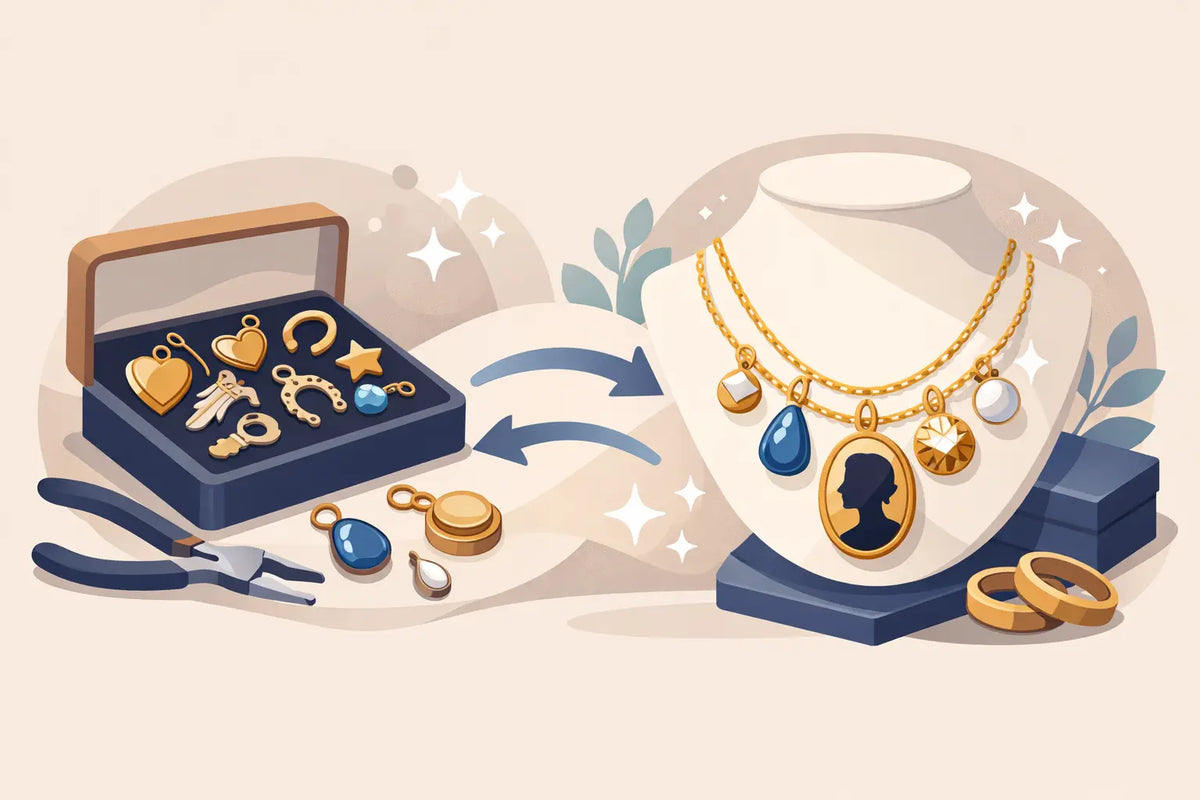
A single charm can be transformed simply by changing its scale, placement, or company. A treasured charm that once hung among dozens may become a pendant on a substantial gold chain. This works especially well for pieces with a distinct silhouette - a heart, coin, shell, animal, initial, or miniature object - because the negative space around it gives the form presence.
For a more layered look, place one meaningful charm beside a small diamond, pearl, colored stone, or a newly engraved disc. The contrast between old and new is part of the beauty. A Victorian locket might look unexpectedly modern on a clean, rounded bail; a sentimental gold medallion can feel lighter when paired with a delicate chain rather than a traditional bracelet.
Charm bracelets offer another kind of intimacy. Instead of rebuilding a full, jangling strand, consider a restrained edit of three to seven charms. Let one serve as the anchor and vary the others in size and texture. A small group moves more elegantly on the wrist and is easier to wear alongside a watch, cuff, or favorite chain bracelet.
If you have several tiny charms, a charm cluster can be lovely. Arrange them at the center of a necklace, at the clasp of a bracelet, or along an elongated chain at uneven intervals. The composition should feel collected rather than perfectly matched, like sea glass gathered over many walks by the water. Keep enough space between elements so each memory can be seen.
Choose a Form That Honors the Original Piece
Not every charm is suited to every redesign. Lockets and photo charms are often best preserved as pendants, where their faces remain accessible. Flat medals can be layered, framed, or turned into a charm enhancer that slips over different chains. Three-dimensional pieces need enough room to move without catching, so a bracelet or heavier necklace may serve them better.
A charm with a weak loop should not simply be forced onto a new chain. A skilled jeweler can assess whether the bail needs reinforcing, whether a jump ring should be soldered closed, or whether a custom setting would better protect the original. These quiet structural decisions matter, particularly when a piece has already crossed generations.
Let Material and Proportion Guide the Design
Old jewelry rarely arrives in a single shade of gold. You may find warm yellow gold beside rosy antique gold, silver-toned pieces, enamel, pearls, or stones with visible wear. Mixing metals can feel effortless when the design has a clear point of view, but it should be intentional. Repeating one metal in the chain, clasp, or newly added rings helps the assortment feel composed.
Scale matters just as much. A large, weighty charm on a very fine chain can strain the chain and look accidental. Conversely, a tiny charm can disappear against an overly bold link. Bring the pieces together in front of a mirror and test a few proportions before committing. The right pairing makes an inherited object feel as though it has always belonged there.
There is also a practical question of condition. Porous materials, fragile enamel, old glass, shell, and pearls need gentler treatment than solid gold. Some stones may be foil-backed, glued rather than set, or sensitive to heat. Do not polish aggressively or attempt home repairs with adhesive. A professional evaluation can reveal weak links, worn prongs, thinning metal, and hidden repairs before they become losses.
Build a Piece Around One Meaningful Gesture
The strongest custom designs are usually led by one gesture, not every possibility at once. Perhaps it is a grandmother’s initial made central on a necklace you wear with an open collar. Perhaps it is a child’s birthstone set beside a charm from your own mother. Perhaps several travel charms become a bracelet that marks the places where your life changed course.
Engraving can bridge old and new with particular tenderness. A date, initials, or a short word on a newly made element can place an inherited charm in your own timeline without altering the original. Adding a new gold disc behind an old medal, for example, allows you to preserve the vintage face while making the piece distinctly personal.
At Fourteen August, this kind of reimagining is approached as an act of preservation as much as design: creating a new heirloom without asking an old one to surrender its voice. The most compelling result is not a replica of the past, but a piece that lets its history continue.
Know When to Preserve Rather Than Transform
Some charms should remain untouched. A rare antique, a maker-signed piece, a charm with historical hallmarks, or an object whose construction is especially delicate may be better worn with only a minimal adaptation. A removable enhancer bail or a carefully chosen chain can offer a fresh way to wear it without permanent alteration.
This is also true when several family members feel attached to the same bracelet or collection. Rather than dismantling it entirely, consider creating a new piece around one charm while keeping the original intact. Or divide charms only with clear family agreement, documenting who received what and the stories attached to each piece. The provenance is part of the inheritance.
Restyling is most satisfying when it respects both sentiment and use. If a charm will be worn daily, choose durable construction and a secure closure. If it is too fragile for regular wear, let it become an occasional piece, brought out for dinners, anniversaries, and moments when its story feels especially close.
A jewelry box is not a resting place for memories. Choose the charm that still makes you pause, give it a setting equal to its meaning, and let it catch the light again - not as a relic, but as part of your life now.