How to Match Necklace Lengths to Your Style
A necklace changes its character the moment it settles against the skin. The same gold chain can feel crisp at the collarbone, intimate at the hollow of the throat, or quietly dramatic as it falls over a silk blouse. Learning how to match necklace lengths is less about following a strict formula and more about noticing proportion, neckline, and the story you want a piece to carry.
A fine necklace often becomes part of the rhythm of getting dressed: a familiar pendant before a morning meeting, a chain that catches the late-afternoon sun, a charm worn close because it holds a name, a place, or a season worth remembering. The right length lets that meaning remain visible, comfortable, and entirely your own.
Begin With Where the Necklace Falls
Necklace measurements refer to the full circumference of the chain, but the way a length sits will vary from one person to the next. Neck size, posture, shoulder width, and the scale of a pendant all play a part. A 16-inch necklace may rest neatly at one person's collarbone and sit higher on another.
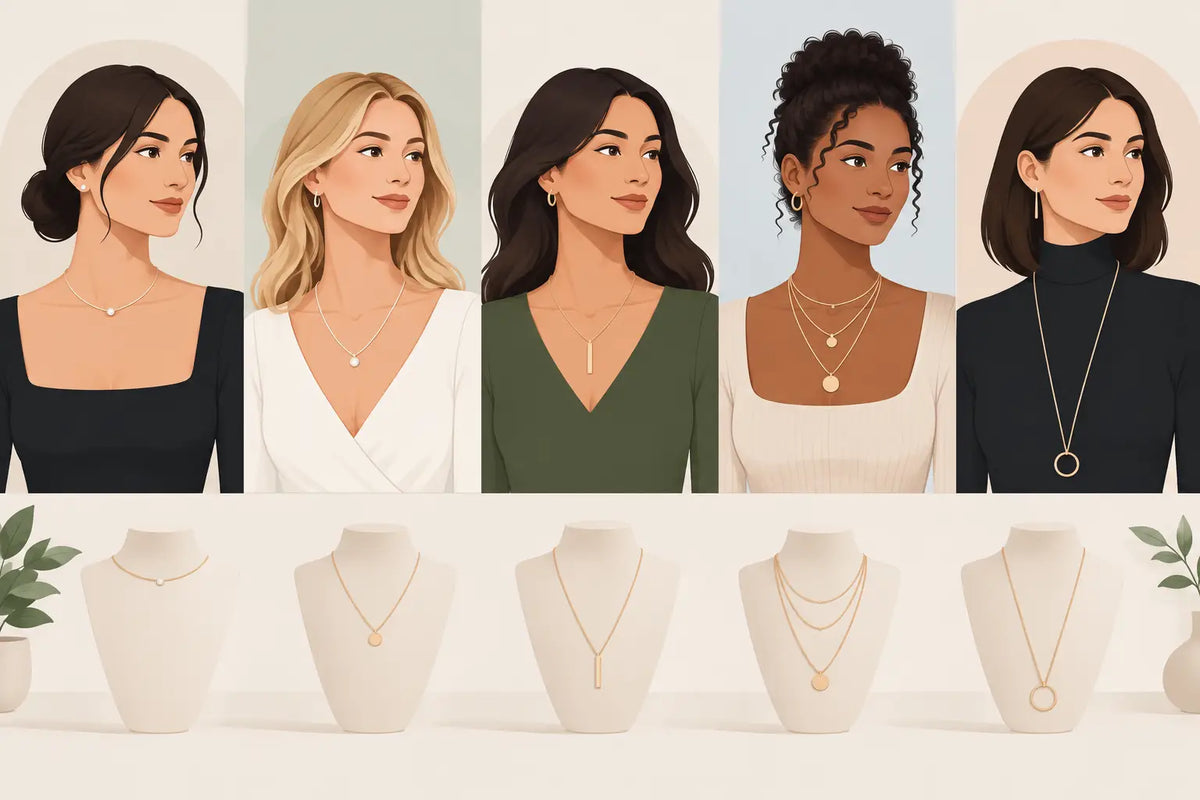
The most useful lengths to know are the classic ones. A 14- to 16-inch chain sits close to the neck, often at the base of the throat. An 18-inch necklace generally reaches the collarbone and is one of the most versatile choices for daily wear. At 20 to 22 inches, a necklace falls below the collarbone, creating more space for a pendant or a button-down neckline. Longer lengths, from 24 inches onward, bring an easy sense of movement and can add softness to a simple dress or knit.
Rather than choosing from a number alone, try a ribbon or a spare chain at the intended length. Stand in natural light and look at it with the necklines you reach for most. The mirror will tell you more than a measurement chart can: whether the line feels balanced, whether a pendant has room to breathe, and whether the necklace disappears beneath your clothing when you want it to be seen.
How to Match Necklace Lengths to Necklines
A necklace should feel in conversation with a neckline, not crowded by it. With a crewneck or high neckline, a shorter chain can create a small point of light just above the fabric, while a longer pendant necklace gives the eye a graceful vertical line over the garment. Both work beautifully. The choice depends on whether you want the jewelry to feel like a quiet detail or the focal point.
Open necklines offer more room to play. An 18-inch necklace is especially natural with a scoop neck, soft V-neck, or open-collar shirt because it follows the open space at the collarbone without competing with it. If you are wearing a deeper V, a 20- or 22-inch pendant often echoes the neckline's downward line with more intention.
Strapless and off-the-shoulder silhouettes invite a closer length. A delicate collarbone chain, a short strand of diamonds, or a meaningful charm worn at 16 to 18 inches keeps the composition luminous without leaving too much empty space. This is also where layering can feel especially romantic, as sunlight catches each small interval of gold.
With a boatneck, turtleneck, or dress with intricate detail at the collar, resist the urge to force a necklace into the space. Earrings, a bracelet, or a ring may be the more elegant choice. Fine jewelry is not diminished when it is edited. Sometimes the most memorable styling decision is to leave the neckline clear.
Let the Pendant Set the Length
When a necklace carries a charm, locket, engraved disk, or one-of-a-kind stone, its placement matters as much as the chain itself. A small, light pendant can live close to the collarbone. A larger or more sculptural piece often needs a little extra length so it hangs cleanly rather than tilting forward or catching at the neckline.
Think about what the pendant means to you, too. A talisman worn every day may feel most natural at 18 inches, visible in an open shirt and close enough to touch without thought. A piece saved for dinners, celebrations, and sun-warmed evenings may be more striking at 20 or 22 inches, where it can rest against bare skin or float over a simple dress.
This is where personal preference outweighs convention. Some women want a locket close to the heart. Others prefer a cherished charm to sit lower, seen in full and allowed its own presence. There is no incorrect placement if it feels comfortable and true to the memory it holds.
Consider Proportion, Not Rules
Necklace length can gently shape the overall impression of an outfit. Shorter necklaces draw attention upward, toward the face and collarbone. Longer chains create a vertical line that can feel elongating, particularly over knitwear, linen, or a clean column of color.
That does not mean certain lengths belong only to certain body types. It means proportion is worth noticing. If you have a petite frame, an oversized pendant on a very long chain may overwhelm the look, while a shorter chain with a smaller scale can feel perfectly considered. If you have broader shoulders or a fuller bust, a 20- to 24-inch necklace may provide a lovely uninterrupted line. But these are starting points, not prescriptions.
The clothes themselves matter just as much. A high-neck cashmere sweater can carry a longer chain beautifully, while an 18-inch necklace may be all a slip dress needs. Texture also changes the effect. A polished gold chain reads differently against bare skin than against crisp cotton or a softly faded knit.
Layer Necklace Lengths With Breathing Room
Layering is most successful when each necklace has a distinct place to rest. Begin with two lengths separated by at least two inches, then decide whether a third adds something meaningful. For example, a 16-inch chain might sit at the throat, an 18-inch pendant at the collarbone, and a 20- or 22-inch chain add a lower, quieter line.
The goal is not abundance for its own sake. Each piece should remain legible. A fine chain can frame a sentimental pendant; a small diamond or gemstone can bring a flicker of light between more personal objects. When every necklace is similar in weight, length, and motif, the effect can become tangled visually as well as physically.
Mixing textures gives a layered look depth. Pair a delicate cable chain with a slightly more substantial link, or let a polished medallion sit beside a slender chain with a subtle stone. Keep the metal consistent for a serene, unified feeling, or blend yellow gold and white gold when the rest of your jewelry already tells that story. The most compelling combinations often look collected over time rather than purchased all at once.
Practical details deserve attention here. If chains twist frequently, increase the space between them or choose one necklace with a slightly different weight. If you wear a pendant every day, build the layers around it instead of asking it to compete. The piece with the deepest meaning should lead.
Choose for the Life You Actually Wear
A necklace does not need to suit every blouse, every occasion, or every version of you. It needs to work within the life you love. If you dress in open collars and silk camisoles, an 18-inch necklace may become an effortless signature. If your uniform is linen shirts, sweaters, and dresses with higher necklines, a longer chain may earn more wear.
It is also worth thinking about the seasons. Shorter layers feel luminous against summer skin, at the beach, or beneath the open collar of a white shirt. In colder months, a 20- or 24-inch necklace brings warmth to wool and cashmere, offering a familiar glint above the fabric. The piece stays the same; the setting changes.
For an heirloom necklace or a custom piece, consider an adjustable chain or an extender. Flexibility allows a necklace to move with your wardrobe and with the years ahead. A length that works beautifully now can remain wearable through changing styles, different occasions, and the eventual joy of passing it on.
The loveliest necklace length is the one that makes you reach for a piece without hesitation. Let it rest where you can see it, feel it, and remember why it became yours in the first place.