Gold Charms Versus Pendants: Which Feels Personal?
A small gold form can hold an entire season: a shell collected after a long walk by the water, an initial that brings someone close, a token chosen at the beginning of a new chapter. When considering gold charms versus pendants, the distinction is less about which is more beautiful and more about how you want your jewelry to live with you. One invites a story that grows over time. The other offers a singular focal point, close to the heart.
Both belong in a thoughtful jewelry wardrobe. Yet their scale, movement, and emotional rhythm are different. Understanding those differences helps you choose a piece that feels as natural as sunlight on the skin.
Gold Charms Versus Pendants: The Essential Difference
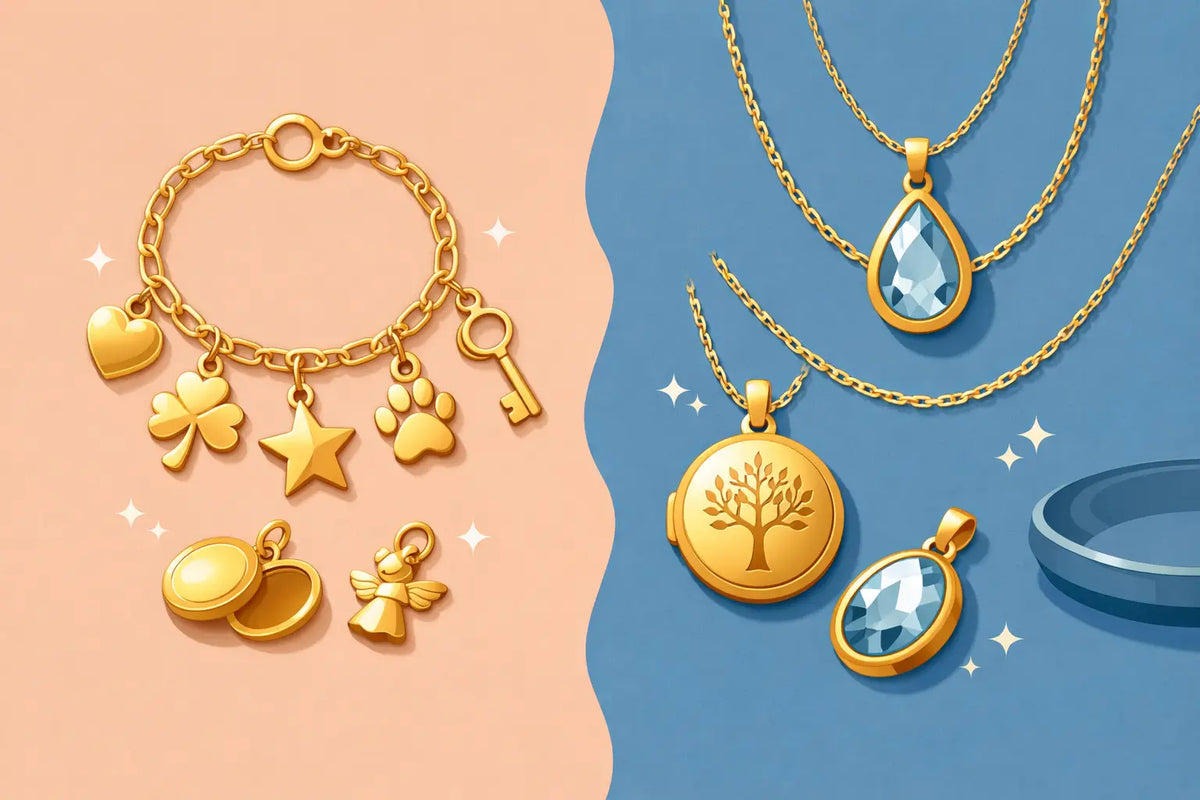
A charm is typically a small decorative object designed to hang from a bracelet, chain, or another piece of jewelry. It is often part of a composition rather than the whole composition itself. A charm bracelet may begin with one meaningful gold token and gather others across birthdays, travels, anniversaries, and ordinary days worth remembering. Even a single charm on a fine chain carries that sense of possibility.
A pendant is usually the central feature of a necklace. It is made to be seen from the front and gives the chain its visual identity. Think of a substantial medallion, a gemstone drop, a sculptural gold disk, or a locket resting in the hollow at the base of the throat. It makes one clear, considered statement.
The terms can overlap. A small charm may be worn alone on a necklace and become pendant-like in appearance. A pendant can also carry symbolism as intimate as any charm. The useful distinction is one of intention: charms are often collected and layered into a personal language, while pendants are more often chosen as a complete, self-contained expression.
Choose a Charm When the Story Is Still Unfolding
Gold charms are especially suited to people who love jewelry with room to evolve. Their magic lies in accumulation, not excess. Each addition can mark a person, place, private joke, wish, or moment that shifted the course of a life. Over years, a bracelet or chain becomes less like an accessory and more like a small archive worn in plain sight.
This makes charms a beautiful choice for milestone gifting. A first charm can honor a graduation, a new baby, a marriage, or a meaningful birthday without presuming to tell the entire story at once. Future charms can follow in their own time. The gift becomes an opening line rather than a final sentence.
There is also a lovely informality to charms. They move as you move, catch the light at an unexpected angle, and create a soft sense of texture when grouped together. On a bracelet, that gentle motion feels intimate, visible to the wearer throughout the day. On a necklace, a small charm can sit close to the collarbone or nest among other pieces with an easy, collected feeling.
The trade-off is that a charm may be visually quieter on its own, particularly if it is petite or highly detailed. If you want a necklace that reads clearly from across a room, a larger pendant may better serve the moment. Charms reward a closer look, which is precisely why they feel so personal.
Building a Collection With Restraint
A charm collection does not need to begin with a crowded bracelet. In fact, one exceptional charm often feels more elegant than a dozen chosen without connection. Start with a symbol you will still recognize as your own years from now: an initial, an object from nature, a talismanic shape, or an emblem of a place you return to in memory.
Consider proportion as the collection grows. Mixing one slightly larger charm with smaller accents creates dimension, while leaving a little space allows every form to breathe. Gold tones do not need to match perfectly, but the overall mood should feel intentional. A softly polished vintage-inspired charm can sit beautifully beside a more sculptural modern piece when both share warmth and purpose.
Choose a Pendant When You Want One Defining Piece
A pendant offers presence. It is the piece you reach for when you want your necklace to feel finished with minimal effort: a white shirt open at the neck, bare shoulders at dinner, a cashmere sweater on a cool coastal morning. Where charms suggest a collection, a pendant creates a center.
For daily wear, that center can be deeply comforting. A pendant with an engraved message, a birthstone, a signet-inspired face, or a meaningful motif becomes a familiar point of contact. You may find yourself touching it while waiting for a call, traveling alone, or stepping into a room that asks something of you. Fine jewelry has a way of becoming part of the body’s own quiet rituals.
Pendants also allow more room for detail. Their larger surface can hold an inscription, a particular stone, an intricate relief, or a design with sculptural depth. If the sentiment you want to express is specific and singular, a pendant gives it space. A locket, for example, keeps its secret close. A sun-shaped medallion may recall a summer that changed everything.
The trade-off is that a statement pendant can be less adaptable than a small charm. Its proportions and placement are more defined, and it may compete with other necklaces if you prefer layered styling. That is not a limitation so much as a design choice. A pendant is often at its best when allowed to lead.
Think About Placement, Proportion, and Your Everyday Life
The right choice often becomes clearer when you picture how you dress and move through a normal week. A charm bracelet is visible while you write, drive, hold a glass of wine, or reach for a child’s hand. It carries a private, tactile pleasure. A pendant rests closer to the heart and becomes part of your portrait, framing the face and neckline.
Chain length changes the feeling, too. A short necklace with a small gold charm feels youthful and close, almost like a secret. A mid-length pendant is more deliberate, especially over an open neckline or fine knit. Longer chains lend themselves to medallions and larger forms, though a delicate charm can look wonderfully unexpected when suspended at a lower point.
Consider weight before deciding. Fine gold jewelry should feel substantial enough to wear with confidence but comfortable enough to become habitual. A charm bracelet with several pieces may make a soft sound and have a satisfying weight on the wrist. A pendant should hang cleanly without turning or pulling the chain forward. If you are choosing a gift, notice whether the recipient favors active, unfussy pieces or loves jewelry with a little more ceremony.
Meaning Matters More Than the Category
The most enduring jewelry rarely begins with a question of trend. It begins with recognition. Perhaps the shape reminds you of salt air and late-afternoon light. Perhaps it honors a family tradition, carries an initial, or simply feels like the version of yourself you are becoming.
This is why the best answer to gold charms versus pendants can be both. A pendant can become the signature piece you wear nearly every day, while a charm bracelet keeps collecting the small landmarks along the way. Their roles are complementary: one holds a single bright idea, the other preserves a constellation of moments.
At Fourteen August, the enduring appeal of fine gold lies in this closeness between form and feeling. A thoughtfully made piece does not need to announce its meaning to everyone else. It only needs to feel true when you fasten it in the morning.
If you are deciding between the two, begin with the memory you want to keep near. Let that memory choose the scale, the shape, and whether it belongs as one luminous focal point or the first treasure in a story still being written.