Signet Rings and the Art of Wearing a Story
A signet ring begins with a small, deliberate surface: a face made to carry a mark. Once used to seal a letter in wax, it now holds a different kind of message - an initial, a crest, a date, a symbol known only to its wearer. Signet rings have endured because they make the personal visible, giving memory and identity a form that can be worn every day.
There is something especially compelling about their quiet authority. A fine chain catches the light; a gemstone brings color to the hand. A signet ring feels closer to a signature. It is intimate, substantial, and designed to become more familiar with every season of wear.
Why Signet Rings Still Feel Personal
The earliest signet rings were functional objects. Their engraved faces pressed into warm wax to authenticate correspondence, often bearing a family crest, emblem, or monogram. The impression was proof of who had sent the message. Over centuries, that original purpose gave the ring a lasting association with heritage, belonging, and private history.
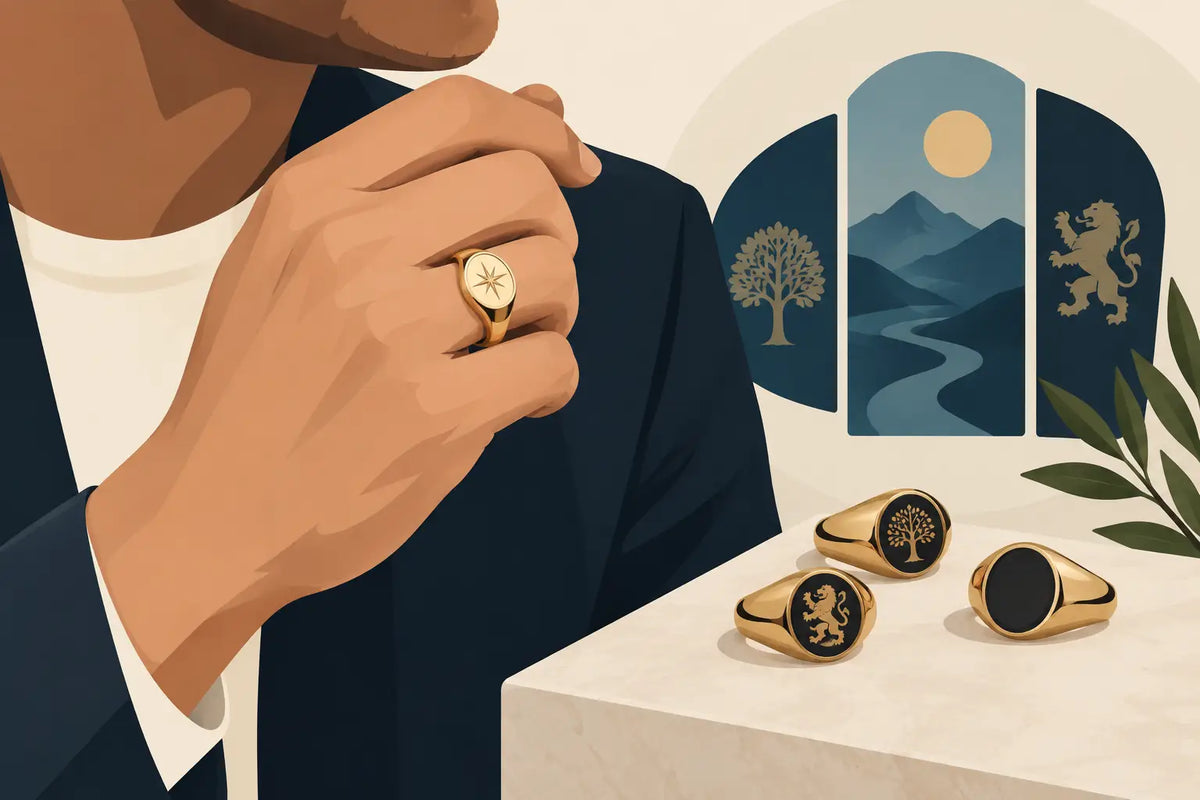
That history remains part of its appeal, but a modern signet need not come with a centuries-old coat of arms. For many women, the most meaningful engraving is simpler: a child’s initial, the letter shared with a partner, a birth flower, a tiny star, a line of handwriting, or a symbol that recalls a particular summer by the water. The meaning does not have to be legible to everyone else. In fact, a little privacy is part of the romance.
Unlike jewelry chosen for a single occasion, a signet is often selected for the life that follows. It can mark a graduation, a new name, a milestone birthday, a marriage, or the arrival of a child. It can also honor no occasion at all, which is its own lovely reason. A piece chosen simply because it feels like you may become the one you reach for most.
The Shape of a Signet Ring Matters
A signet ring’s face determines much of its character. Oval signets are soft and classic, with a graceful proportion that suits a script monogram or delicate motif. A round face feels balanced and understated. Cushion and rectangular forms offer a more architectural presence, especially beautiful with block initials, an intaglio design, or a cleanly engraved date.
Scale is equally personal. A smaller signet can sit like a secret on the pinky or ring finger, layered easily among slim gold bands. A larger face has the poise of a statement piece, often best worn alone or beside one restrained companion ring. Neither is more correct. The right proportion depends on the hand, the gesture, and whether you want the piece to whisper or announce itself.
Consider the profile, too. A low, gently domed signet tends to feel easy and natural in daily life. A higher face can create a more traditional silhouette, with a little more ceremony. The beauty of fine jewelry is often in these details: the curve against the finger, the weight of gold, the softened edge that makes a ring feel as though it has always belonged to you.
Gold, Stone, or Engraving?
A polished gold face is enduring for good reason. It offers a warm, uninterrupted field for an engraving and develops a soft patina over time. Small marks and faint scratches are not necessarily flaws in a well-loved signet. They are evidence of hands held, tables set, suitcases packed, and ordinary days that mattered more than they seemed at the time.
Gemstones introduce another layer of expression. Onyx creates crisp contrast and a slightly more formal mood. Carnelian brings an old-world, sunset warmth. Lapis has the deep blue of late afternoon water. A stone-set signet can be striking, though it asks for a little more consideration in everyday wear. Softer stones may be more susceptible to scratches, and an ornate setting may feel less effortless if your intention is to wear the ring constantly.
Engraving is where the piece becomes entirely your own. A single initial is timeless and beautifully restrained. Two or three initials can suggest a family name, a partnership, or a personal motto. A crest may honor ancestry, while a custom motif can create a new tradition. The best choice is rarely the most elaborate one. It is the one that will still feel true when you look at your hand years from now.
How to Choose a Signet Ring You Will Wear
Begin with the story, not the styling. Ask what you want the ring to hold. If the answer is a private reminder, choose a motif with meaning rather than one that follows a passing trend. If it is meant as a future heirloom, think about an image or inscription that can remain resonant as the piece changes hands.
Then consider your daily rhythm. If you work with your hands, travel often, or prefer jewelry you never have to think twice about, solid gold with a low profile may be the most practical choice. If you reserve jewelry for dinners, celebrations, and weekends away, a gemstone or more pronounced silhouette may feel exactly right. Fine jewelry should invite wear, not wait indefinitely in its box.
Finger placement changes the mood. The pinky carries the signet’s traditional confidence, while the index finger gives it a modern, intentional presence. On the ring finger, it can feel softer and more sentimental. Some prefer a signet on the middle finger, where it becomes a centered, sculptural anchor among more delicate pieces. Try on different sizes and placements before deciding. A ring can be beautiful in the hand and still not feel like your hand.
There is also the question of orientation. A vertical oval lengthens the finger and feels traditional. Worn horizontally, the same shape becomes more unexpected and contemporary. This small decision can change the entire personality of a ring without changing its essential form.
A Modern Heirloom Is Meant to Be Lived In
The idea of an heirloom can sound formal, as though a piece must wait decades before earning that title. But heirlooms begin much earlier. They begin when a ring becomes part of your rituals: slipped on before a flight, caught in the light while carrying a coffee to the porch, worn for the photo no one planned to frame but everyone eventually loves.
This is why craftsmanship matters. A signet ring should have a satisfying weight, balanced proportions, and an engraving made with care. It should feel considered from every angle, including the parts no one else sees. Handcrafted in New York City, Fourteen August approaches fine jewelry as an object of memory - not merely a finishing touch, but something made to gather a life around it.
A well-made signet also welcomes change. It can be resized when appropriate, restored after years of wear, or passed down with a story attached. If you inherit an older ring, you may choose to preserve its original engraving as a record of the person who wore it before you. Or you may reimagine it, allowing inherited gold or a family stone to take a new shape. Both choices honor the past. One preserves the object; the other extends its life.
Wearing a Signet Ring With Ease
A signet ring does not require a special occasion or a carefully constructed stack. Its strength is that it holds its own. Wear one with a white shirt and sun-warmed skin, with a cashmere sleeve on a cold morning, or with an evening dress that needs only one finishing note.
For a layered look, keep the surrounding rings light enough to let the signet remain the focal point. A slim diamond band or a simple gold ring can add texture without competing. If your signet has a substantial face or dark stone, give it room. The most elegant styling often comes from knowing when to leave space.
Over time, let the ring become less precious in the anxious sense and more precious in the meaningful one. Remove it for swimming, heavy exercise, gardening, and tasks involving harsh chemicals. Otherwise, wear it. Let it accompany the days that will later become the stories worth keeping.
Choose a signet ring not for the version of yourself you think you should become, but for the life already taking shape in your hands. The right mark can be simple, the gold can gather its own gentle patina, and the story can remain yours until the day you are ready to share it.